
Reporting can produce stories without raising anxiety levels within a community. This was a social media thread I accidentally deleted, but now it’s a post about what I mean, using a climate-crisis-driven example, as I sit outside typing on a 32°C morning in Brisbane’s first week of official calendar-based spring. Is that level of heat rare? Yes. Is it unique? No. Does that distinction matter? Yes. Should we use the discomfort to tell our leaders we expect more? Yes. Is there still time to avoid a terrible future? Yes.
Click for less
Those who know me know I am really not a fan of headlines and clickbait that draw you in by deliberately seeking to exclude historical context.
As a Dad with a family of history nerds, I have a strong awareness of how essential a good knowledge of history is for interpreting the world around us. Especially around the current surge in the politics of authoritarianism.
Historical context is one of the early targets for such regimes to affect – even the centre-right regimes – rewrite, ablate, and generally squish through a filter of nationalism laced with a yearning for the falsely imagined ‘good old days’. History tells us that’s happened before, and that the cycle ends badly. It tells us how that’s happened before. And yet the wheel turns again. Historical context also tells us there wasn’t a utopian past – just childhood innocence and reimagining. This is where the duty of the media, if such a quaint concept even exists today, lies: to help remind us of the context for what’s happening around us.
But this piece of writing isn’t about politics; it’s about remembering that we may have seen a thing before, despite the pulse-stimulating screech of a headline or the memory-erasing whine of the bots, their masters and the true believers trying to convince us to focus on this, now, it’s what matters.
THIS is the worst thing
I get annoyed by a headline that says “This is the worst XYZ in history”.
I presume the aim is to garner your attention, your mouse button, or the electrostatic presence of one of your appendages.
More clicks mean more advertisers, which means more funds to pay staff. Well, possibly just funds to make shareholders and CEOs more profit rather than to pay staff what they need to live in a world ravaged by profiteering oligarchs.
@#!$. Politics again.
Influenza is probably the headline you’ve seen me write about most – and mostly on social media. But I’ve also waded in on whooping cough, silly flu-origin names, over-attribution of acute respiratory illness to COVID-19, and super colds. These days the annoying headlines spew forth faster than my typo-correcting, so blog pieces don’t keep up. But that gives you the context for my writing this piece, even as it strays away from that point.
I haven’t actually seen this next issue as a headline yet, but I have seen buzz about it around the pipes…”This is Brisbane’s hottest start to spring ever!”
Is this Brisbane’s hottest start to spring ever?
To be honest, I wasn’t sure either! It’s a fair question in an age that aims to both captivate and rot our brains at the same time. An age training us to put zero effort into finding facts and instead relying on sometimes very wrong, corporate-created databases (“AI”) to feed us an interpreted, perhaps biased, version of answers to our sometimes poorly defined questions. It even offers sources. And on occasion, they even match up with the answer. It’s hard to blame anyone for not doing the work and spending the time it takes to get a personally fact-checked answer to the question of “Is it, though? Reeeeally?”
Nice weather we’re having; shame if it killed you
Today, in some parts of Brisbane, the temperature is predicted to reach 35°C. It’s already 33.1°C.
I found a site with some pretty graphs to look into this a little more deeply, so you don’t have to.
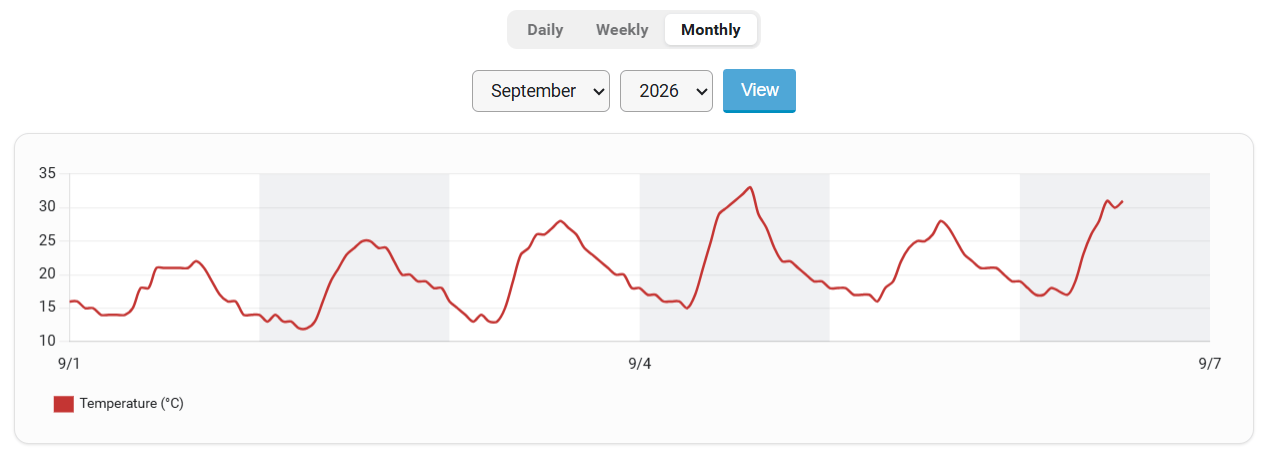
Click on the image to enlarge.
Brisbane has had – six days into the month – two days into the first week of September in Brisbane, recorded at the Brisbane City Station, that have topped 30°C. That’s damn warm for a few days out from the start of a contrived seasonal demarcation (the beginning of spring).
So can I click away now? Sure. Let’s face it – you probably didn’t read this far anyway (comment below, subscribe or ping me a 📲 on socials to prove me wrong!). No!! Scroll on, dammit.
Is there any context to add?
Why, yes there is, and thank me for asking.
Not new, but still a very troubling recent change
This is certainly a story worth writing – very hot days, very early spring. But to be clear, there have been some days in other years when:
- Temperatures exceeded 30°C
- They did that during the first week of spring.
At that pretty graph site (Weather Underground), I searched the September graphs going back to 2004, which is all the graphed data this site had. I found the next year matching my criteria was 2024 (I could have sworn 2025! Goldfish brain), and the next one before that was 2019. No more up to and including 2004.
2014 and 2006 got close, but only managed one day at 29°C.
Maybe good context for a future story would be to note that 30°C+ days in the first week of spring occurred in only 3 of the last 23 years, but all in the last 8.
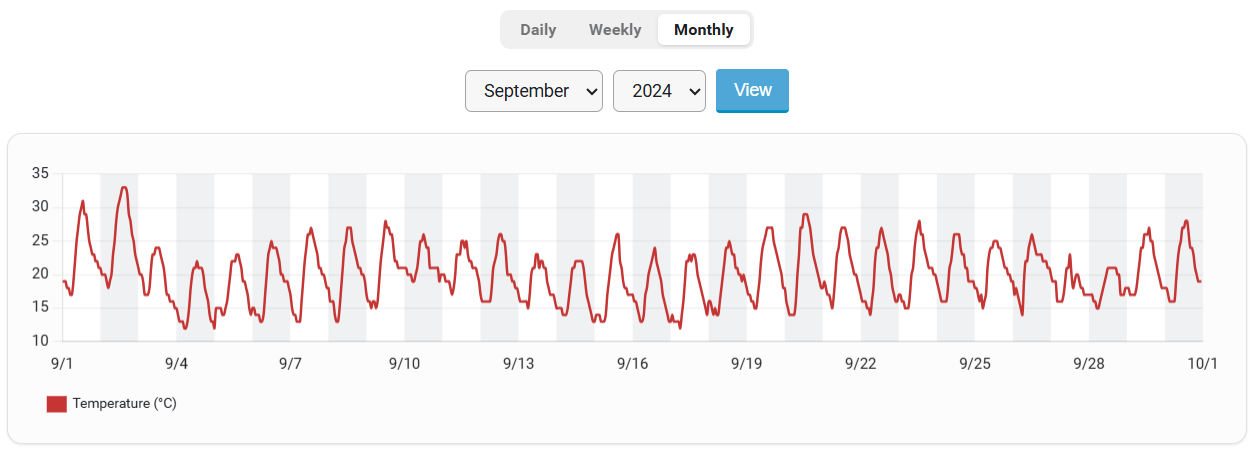
Click on the image to enlarge.

Click on the image to enlarge.
I get it. We are being trained to have the memory of a goldfish by outsourcing our critical thinking to a resource-consuming black-box spellchecker.
Despite having access to public data – even when it’s raw or crudely presented (😒BOM) – it takes time and energy to extract that context to communicate a clearer context. Who has that sort of time? I mean, I’m way too busy training the boss’s AI bot for the ‘next time I’m on holiday’ so ‘we can be as efficient as possible’.
Adding in some context
Wouldn’t it be great if context was part of a list and it had to be checked off for every story the media published?
In this example, I think there are at least a couple of points that should be included:
- 2026 is one of three years in the past 23 years of recorded data that have breached 30°C on one or more days in the first week of spring. But they’ve all occurred recently over the last third of that time, and 2026 has been the hottest.
- This unexpected discomfort you’re feeling. This extra expense from running your aircon. This increase in heat deaths you’ll hear about sometime much later. This need to pay for more drinkable water to keep your lawn green. This is reaping the different costs of what we’ve all sown, voted for and supported for decades, despite warning after warning. We’ve created a climate crisis. While this is only the beginning – water supplies and failed crops are already in our news cycle – we can slow, and even arrest, the rate of change driven by the climate crisis. It’s not a done deal. Unless we do nothing.

The United Nations Environment Program released a lengthy but understandable report on the climate crisis this week. There is still hope, but once again, this is a warning to us to act now. A conversation starter. Perhaps a final warning. Preventing things from getting any worse is entirely up to us, the creators of the problem.
We can affect this, but we have to see leadership we can elect. And then vote for it. We have to care about each other. It’s a rotten time to be racist pricks in a misogynist manoverse of mindlessness. Human-induced climate change is the biggest threat facing us today – it impacts our food and water – and it doesn’t get any more real than that. We have to stop fuelling it while simultaneously ignoring it. We have to prioritise our future instead of the profits of a relative few. We have to use our brains.
The context for this issue is already all around us every day. Out the window, in the news, populating our feeds – perhaps even in those controlled by the programmed algorithm. Use this context to understand why a hot Spring day isn’t a unique event, but one of many signs of the start of the end, so long as we keep consciously choosing to do nothing.

Note on confirming the pretty graphs
The Weather Underground website cited the Weather Channel as its source for the data in its charts. I looked at our Bureau of Meteorology and confirmed the pattern there. They are a little more…raw. You can plot their detailed year-by-year tables, but the graphs are a bit nerdy and not as pretty.
Sources
- https://www.wunderground.com/history/daily/au/brisbane
- https://www.bom.gov.au/jsp/ncc/cdio/weatherData/av?p_nccObsCode=122&p_display_type=dailyDataFile&p_startYear=1999&p_c=-334879713&p_stn_num=040913
Discover more from Virology Down Under
Subscribe to get the latest posts sent to your email.
Short of installing solar panels, batteries, rain tanks and trying to grow some produce, what can an individual do to fight against the disregard for scientific evidence? I become more despondent every day. I guess the next step is to donate to Friends of Evidence.
That is doing your bit! You’re a great example.
I came for the virus info, but good to see your stats on weather, I’m based the other side of the globe where we are just coming out of a summer that while beautiful was unsettling in terms of what it is foreshadowing.