
There are a few concerning media stories of empty offices and schools in New Zealand due to respiratory illnesses – coughs and colds and “the flu”. So is #NZflu2026 in New Zealand (NZ) a big flu year?

New Zealand and influenza in 2026
#NZflu2026 is happening. No argument.
The data dashboard below is New Zealand Acute Respiratory Illness Infections for the week ending 9/08/2026 (‘Viruses detected’ tab). We can see flu (pale blue segments of the bars) making up a big chink of severe acute respiratory illnesses (SARI) during August as the season has grown.
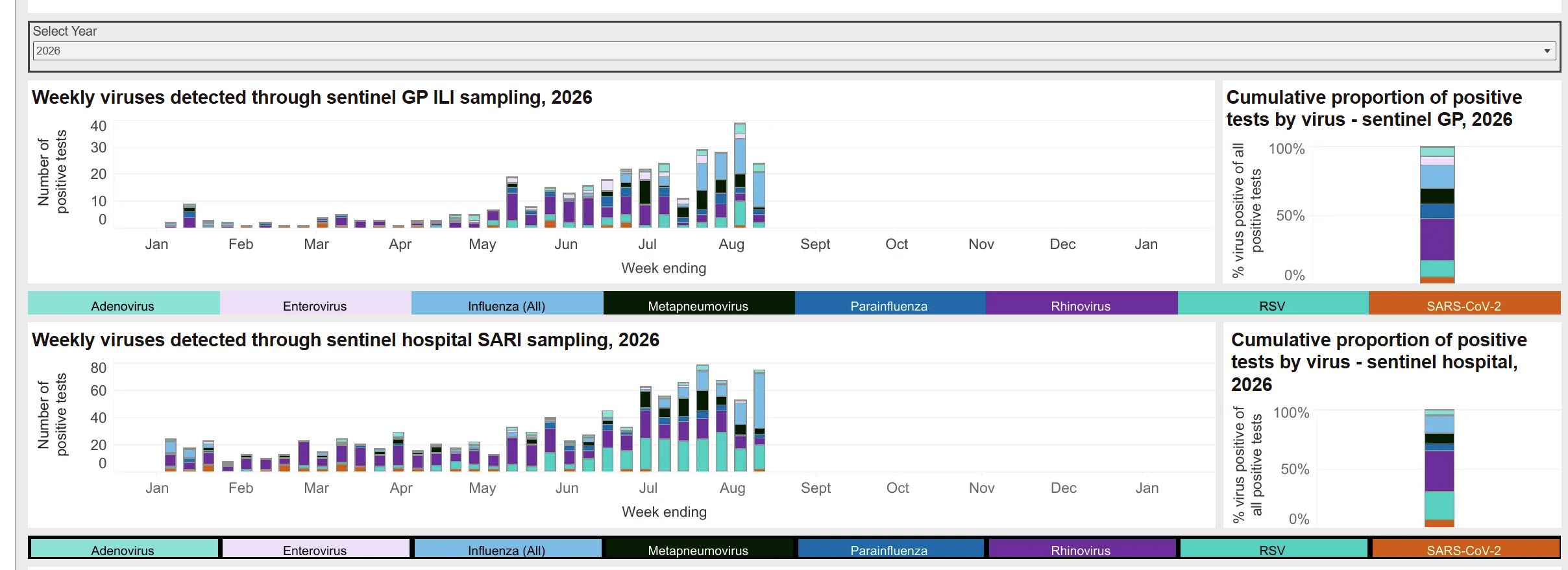
https://www.phfscience.nz/digital-library/respiratory-illness-dashboard/.
Click on it to enlarge it.
The NZ data are a bit ‘managed’, which may also make it harder for the media to remember that influenza existed before that little thing we call “the pandemic”. And that some pre-pandemic years were also quite big and/or harmful. Could that context be useful?
For example, if you were to play around with this dashboard (I’m now on the ‘Hospitalisations’ tab below), you’ll find that 2022 (pale grey) was both early and huge in terms of SARI counts. 2025 peaked a tad earlier than the 2015-2019 average (black), while 2024’s peak was both broader and of higher SARI activity and preceded whatever’s happening in 2026, which has now strayed into the ‘High Activity’ range.
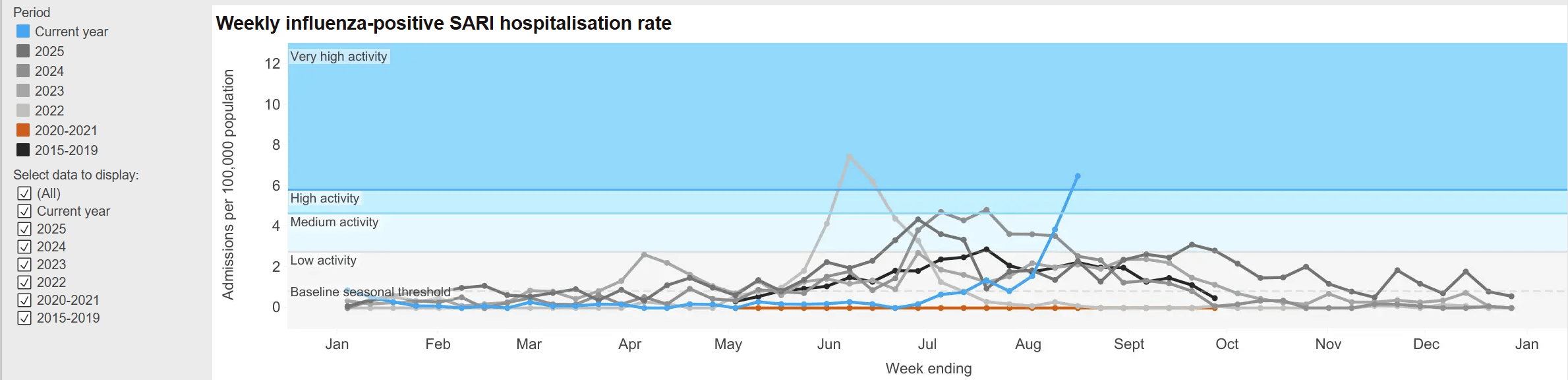
Click on the image to enlarge.
As an aside, gatekeeping data can lead to misinterpretations and prevent better and more analytical reporting of outbreaks and epidemics. It can also contribute to exhausting and trust-eroding “worst epidemic ever” headlines that are simply poorly informed or unable to get a relevant expert comment or access what should be public-facing public data.
There is a more comprehensive version of the historical annual disease data on the notifiable diseases dashboard; however, NZ, unlike Australia, does not list influenza as a notifiable disease.
Historical flu timing in New Zealand
A recent nice Kiwi video focuses on the flu as the cause of the current wave of illness emptying offices, and suggests it will continue into spring (roughly Weeks 36 to 48, or September, October, November). Making it a late season.
One past year was bigger and earlier – 2019. The 2015-2019 average (black line below from a research study) shows that flu typically peaked around week 31-34 pre-pandemic. Although the average does dull the peak timing of 2019’s SARI impact. Right now we’re in Week 33.
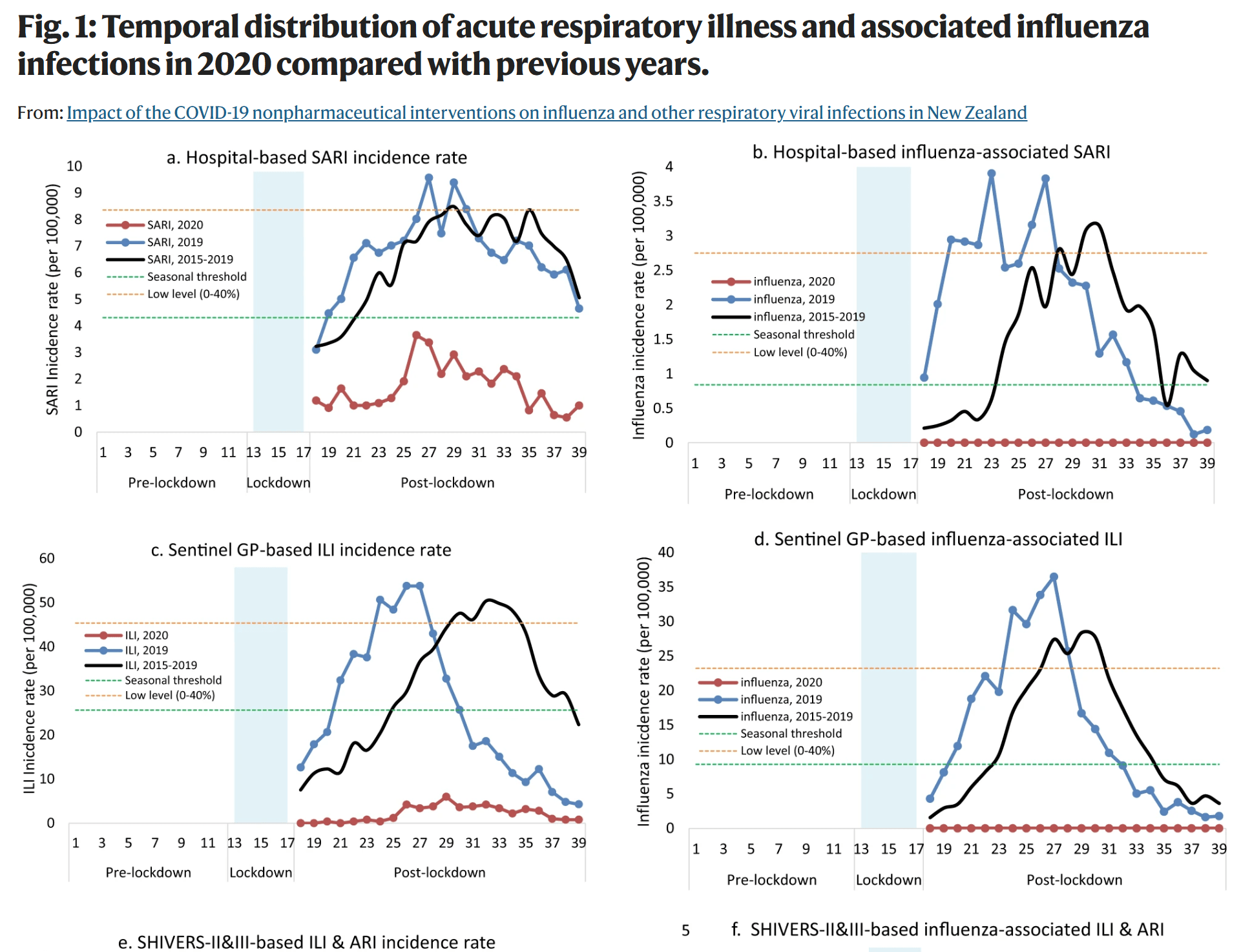
Image taken from Fig. 1: Temporal distribution of acute respiratory illness and associated influenza infections in 2020 compared with previous years.
Click on the image to enlarge.
If we look at the immediate post-peak of the pandemic years, flu epidemics in NZ peaked around July/August. 2018 peaked in Week 33; in 2017, it peaked early in July.
Below, you can see SARI peaks that shift from Week 28 to Week 38-ish across earlier years, but flu detections are typically in steep decline by Week 39 (end of September).
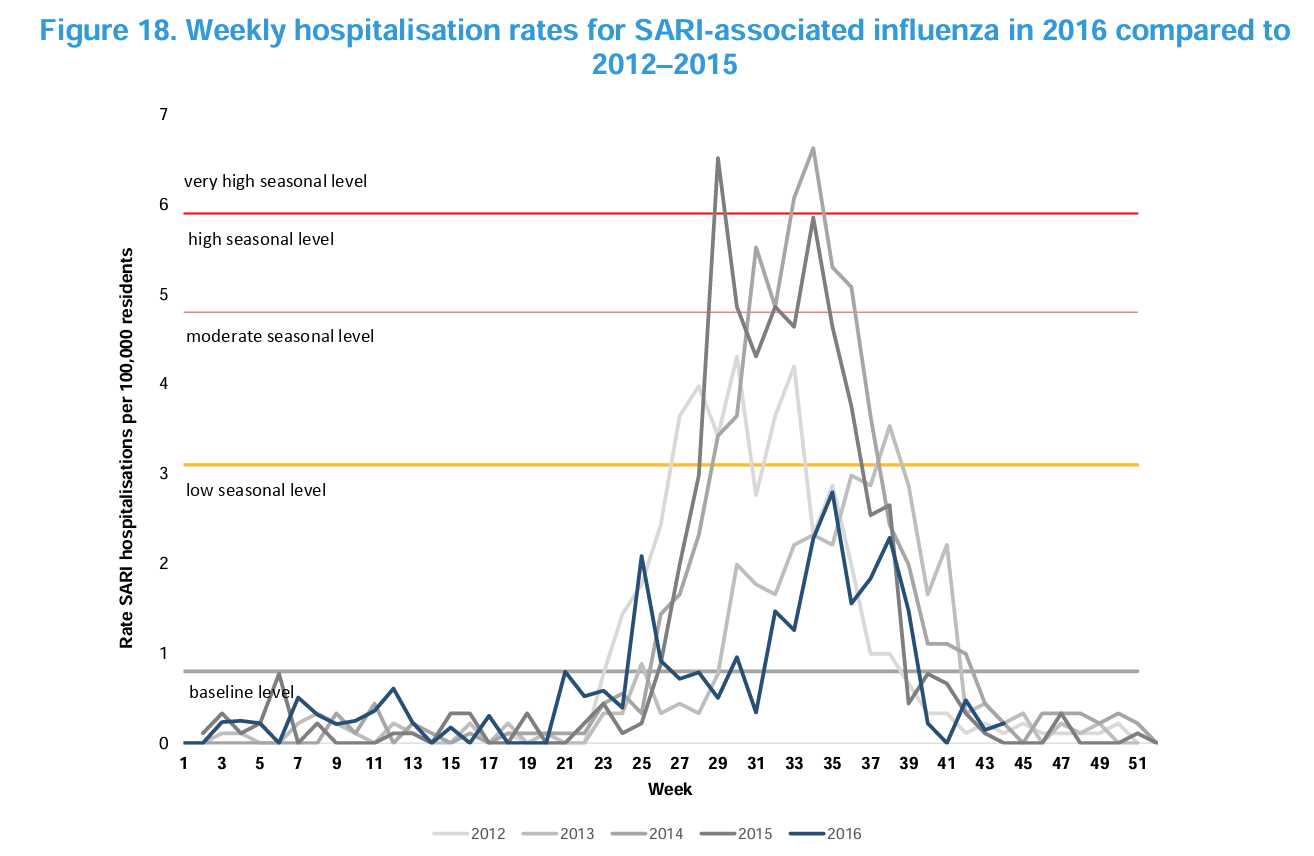
Click on the image to enlarge.
This alignment of each NZ flu detection year by week from 2022-2026 plus 2019 shows peaks of all shapes, sizes, and timing depending on the source, year, and virus activity. Flu detections generally peak before September, but not always.

What’s in a peak?
Peaks alone don’t tell the story of a flu season’s severity, though. That comes from an analysis of intensive care admissions and deaths, and it’s possible those could be higher in a smaller, peaking year. So it’s complex, and the explanation doesn’t fit easily within 280 characters. But for the story of seasonality, this gives us an idea about NZ. From what we can see of the current flu trajectory, New Zealand might indeed be in for a late peak.
Flu took off in August in NZ

Click on the image to enlarge.
It looks like SARI cases that are flu-positive (pale blue below and on the right) are taking off now in New Zealand.
Before August, respiratory syncytial virus (RSV; pale green below), rhinoviruses (purple below) and human metapneumovirus (MPV; black below) were making themselves felt.
It’s always tough to say when a flu season will peak – they are unpredictable – but it doesn’t look like it will be today!
If you haven’t had the flu vaccine, Kiwis, now is a good time to have a chat to your doctor, nurse, healthcare provider, or pharmacy.

Click on the image to enlarge.
Australia’s flu detections are still heading upwards. It may be a small peak or a big one, but with 10 days to go in August and the daily detection rate still growing, it’s still possible it will be a fairly normally timed (pre-pandemic) August peak.
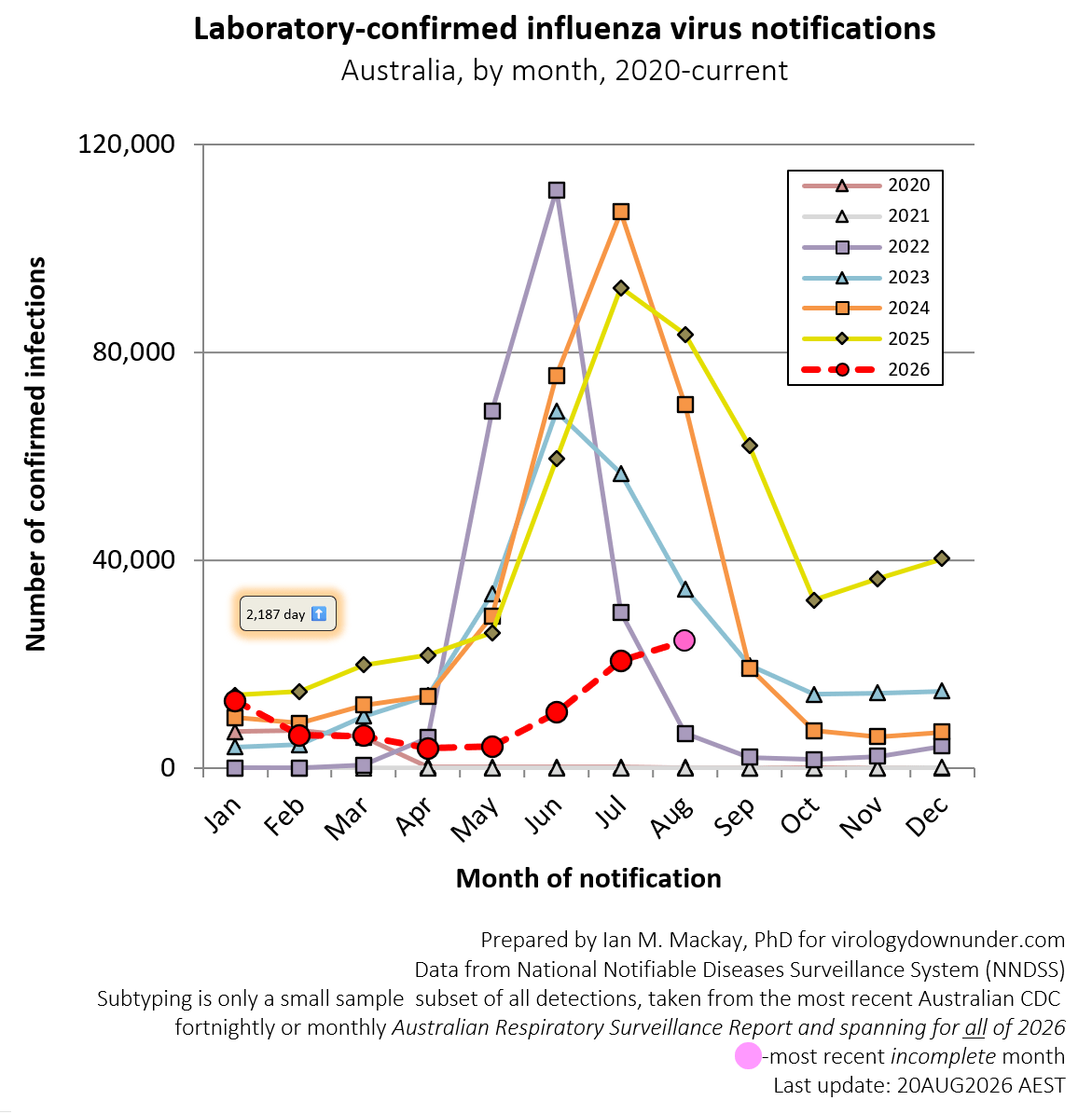
Click on the image to enlarge.
Pre-pandemic, Australia’s peak flu month was often August, but the pandemic had messed with those patterns for about five years.
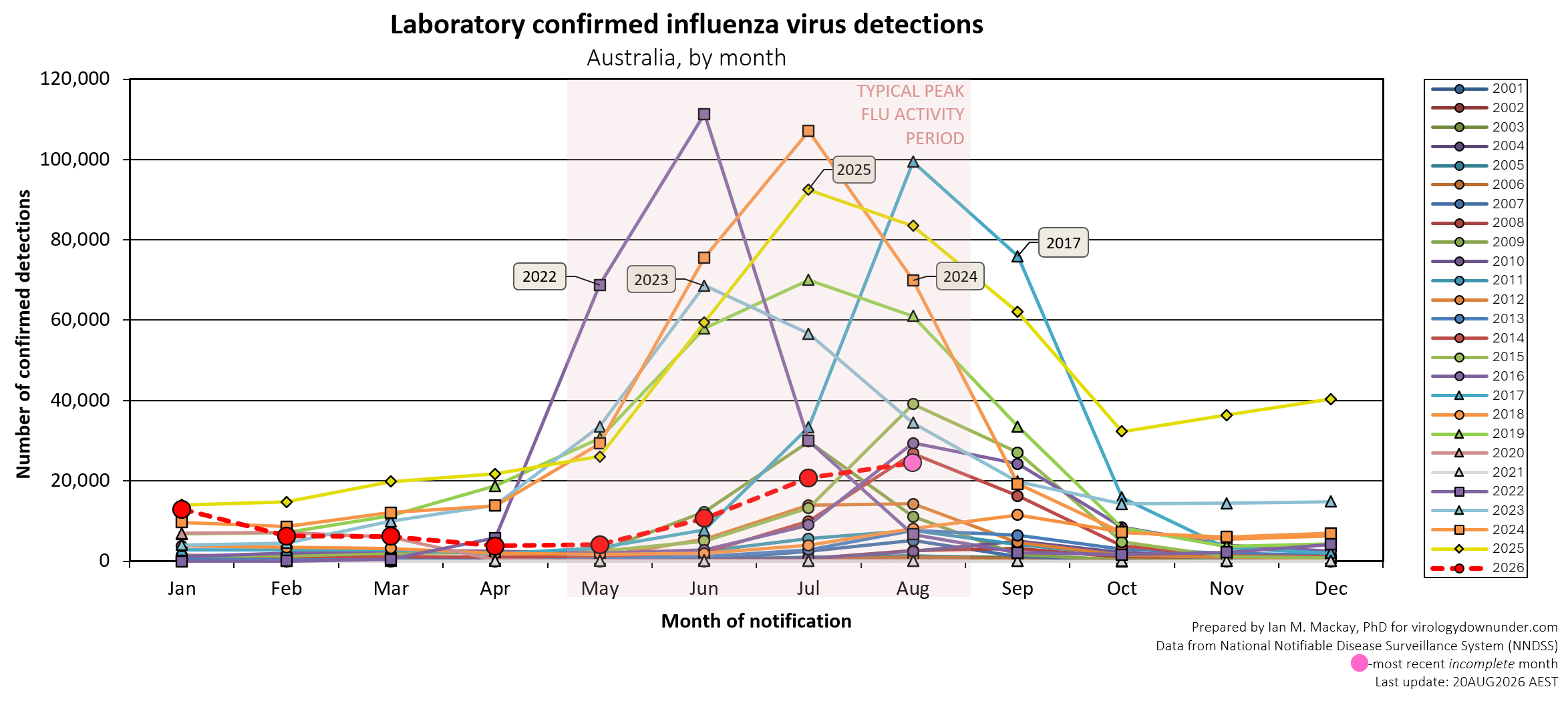
Click on the image to enlarge.
Is Australia having a severe flu season?
Nope. We’re not hearing reports of rising numbers of severe flu cases or of abnormal levels of absenteeism via the Australian media so far, or in the national report. Among serious acute respiratory illness in 2026, most is attributed to RSV and COVID-19. Three or more days absent from work or normal duties is also at lower levels than during the same period in 2023, 2024 or 2025.
For those wondering, in New Zealand COVID-19 is currently at very low levels, so my money is on RSV, MPV, and rhinoviruses driving illness in schools and offices pre-August.

Click on the image to enlarge.
So what?
New Zealand is experiencing a later-than-normal flu peak, following a busy RSV, rhinovirus, and MPV period that may already have had a significant impact on kids. Perhaps Australia’s later-than-pandemic-years flu peak is influencing the #NZflu2026 burden as our infected travellers come bearing viral gifts. You’re welcome!
Australia still appears to be on track to reset its flu peak timing to a pre-pandemic pattern, but for now, it is experiencing one of its smaller, relatively milder flu seasons.
“Will this mean I’m in for a late flu season in my home country of [northern hemispheratus]”? No. Yes. Maybe. Maybe not.
Throughout this season, the flu viruses have been mutating in each human they pass through. Changing and adapting. And the same has been happening in other parts of the world. All new variants are emerging, and any one of them coudl be the next big thing to take the northern winter by storm. Or it could be brewing away right now in your country of northern hemispheratus.
Time will tell how the seasons of these two countries play out and what the northern winter is in store for.
References
- https://www.rnz.co.nz/news/education/1056808/winter-illnesses-harming-students-education-nzpf-president-says
- https://www.phfscience.nz/digital-library/respiratory-illness-dashboard/
- https://www.phfscience.nz/digital-library/notifiable-disease-dashboard/
- https://www.nature.com/articles/s41467-021-21157-9/
- https://youtu.be/Awx6HUIGraE?si=3CTJDflO6N26viT3
- https://www.phfscience.nz/digital-library/influenza-annual-report-2016/
- https://www.healthnz.govt.nz/health-topics/immunisations/vaccines-aotearoa/flu-vaccine
- https://www.cdc.gov.au/resources/publications/australian-respiratory-surveillance-report-27-july-2026-9-august-2026
Acknowledgement
My thanks to Catherine and her timeline of NZ flu posts for providing the idea for this post.
Discover more from Virology Down Under
Subscribe to get the latest posts sent to your email.