
Seasonal influenza viruses (as shown in the image below) drive epidemics that rely on both year-round circulation in the tropics and air travel, using giant conveyor belts of virus distribution, namely China and Southeast Asia, to disperse worldwide. During the COVID-19 pandemic, influenza viruses suffered due to reduced transport. No, they didn’t just get called SARS-CoV-2 instead (conspiracy theory). No, we didn’t stop testing for them either (conspiracy theory). We simply smashed them by separating the things they really rely on for epidemic fuel – us and us moving around.

What do influenza viruses really need?
At the most basic level, respiratory pathogens like influenza viruses need two things to replicate and spread: they need to make a journey (travel = transmission) and reach a receptive destination (the host, us).

Some respiratory viruses journey or ‘transmit’ between hosts using surfaces like someone’s used handkerchief or a light switch. An intermediate. To varying degrees, air is also a common route for viruses to travel between infected and uninfected hosts.
Those two terms are each onions; there are many layers to consider within each of these broad terms. There’s the nature of the virus, the dose of virus nboth sent and received, how it enters our body, the environment it travels through, competition between variants and lineages of a virus, the immune status (really important) of the host, and the ways an infected host moves around. Each of those factors is important, and they work together to produce an epidemic at the population level, but some can also impact the severity of any resultant disease at the individual level.

But for a virus to infect you – regardless of the signs or symptoms that result from that infection – it needs to reach you first.
How does this relate to smashing the flu during the peak of the pandemic response? Before we get there, let’s just address the conspiracy theory that we stopped testing for influenza viruses so it only looked like it went away.
So what changed about flu viruses during the pandemic?
Simply put, seasonal influenza virus circulation was impacted by a drop in international air travel, particularly. The stoppage didn’t occur overnight, but as new variants weren’t being constantly injected into populatiosn all over the world and the fittest weren’t being selected and expanded, the existing local variants in each juridiction ran their course, finding it more difficult to get a genetic boost to help avoid the building of loacal immuntiy and the absence of a new and suitably proximal destination – think Jean Grey’s telepathic initial jump distance limitation in Spider-Man: Brand New Day!
So once close contacts were either pulled apart or exposed to infection and became immune, virus detection dwindled because influenza could no longer undertake the journey (transmission) it needed to reach greener destinations (hosts). You can see that dwindling over time across the four seasonal influenza virus lineages (the four are named in the first image above) in this next image…detections dropping off to almost nothing over the period. And for one lineage of viruses – B/Yamagata – they dwindled out of existence.

Figure 1 is from the Human seasonal influenza under COVID-19 and the potential consequences of influenza lineage elimination.
Click on the figure to enlarge.
A virus banished
The global influenza virus conveyor belt ground to a very slow crawl, and annual seasonal influenza epidemics were smashed. As an unplanned bonus, one of the virus groups that made up the four key players in each seasonal influenza epidemic was obliterated. Influenza B virus variants that belonged to the influenza virus B/Yamagata lineage of influenza viruses have not been detected since March 2020 – over six years – yes, that’s despite lots of testing and typing of positives to be sure. B/Yamagata viruses appear to be extinct, thanks to our actions to prevent human movement and contact during the pandemic.
Why didn’t the same interventions work to remove SARS-CoV-2?
In my opinion, the rapid widespread dissemination of SARS-CoV-2 around the world and the antigenic novelty of this new virus meant lots of ongoing infections and no multiyear baseline of at least some cross-protective pre-existing immunity left open a lot more “destinations” than was the case for B/Yamagata, which mutated less rapidly and had already been in circulation among humans since at least the mid 1970s.
Why didn’t the same interventions work to remove all the other viruses?
To be clear – all these viruses were knocked down a lot. Three possible reasons why they weren’t as impacted as the influenza virus B/Yamagata lineage.
Firstly, B/Yamagata was already the least commonly circulating of the influenza viruses, and it is known that evolutionary changes in influenza B viruses don’t alter their protein sequences as often as in influenza A viruses, so B/Yamagata viruses were a good candidate to go if the circumstances were right.
Secondly, most respiratory viruses are acquired by young children – and often childcare facilities remained open during the pandemic in order for “frontline workers” to keep humanity in toilet paper stocks, save our lives, test our samples, look after our other diseases, care for the elderly, clean up after us. These may have been foci of virus spread: infected children coming together, transmitting to one another, and being sent off to new homes to spread further.
Thirdly, some viruses are more robust than others because they don’t have an important but less tough outer covering of fat (lipid; also called an envelope). These non-enveloped, or ‘naked’, viruses, such as rhinoviruses, enteroviruses, adenoviruses, noroviruses, and so on, can be spread by touch as well as through the respiratory route. So a person doesn’t need to be close to you or to have filled the air in a small space with infectious particles for you to acquire that virus; a contaminated shared surface may act as an intermediate. Transmission of these may be much harder to interrupt, especially in the home and among young children.
Flu testing didn’t stop
That conspiracy theory is a major bust. Anyone who tells you this whopper is signalling loudly that they haven’t looked into the realities at all.
Flu testing kept going because public health cares about people’s health, not just the one infected by the latest thing. And labs can test for multiple viruses using the same patient sample using highly sensitive PCR. Combined (or ‘multiplex’) tests that report on the presence of influenza virus, SARS-CoV-2 and respiratory syncytial virus are now very common. And all cause vaccine-preventable disease.
Quick point: as shown in the figure below from a 2021 Australian report, even though it looked like there were zero influenza cases in 2021, some were still detected when you zoomed in on the data. Testing was still happening, results were still being reported, people were still cared for.
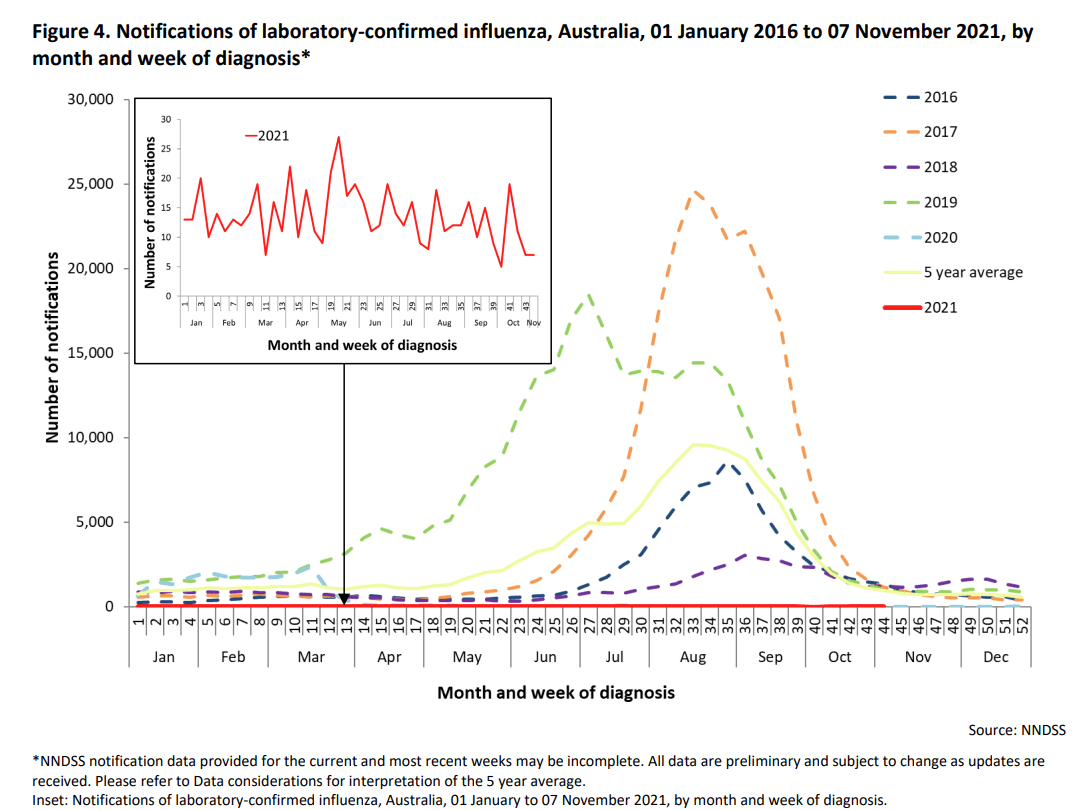
Figure 4 is from the Australian Influenza Surveillance Report, No. 16, 2021, Reporting fortnight: 25 October to 07 November 2021
As an aside, there is a conspiracy theory that the laboratory method, the polymerase chain reaction (PCR), was the sole reason for the COVID-19 pandemic because it was too sensitive and insufficiently specific. I wonder if those …theorists… explain in the comments below how influenza-based PCR tests failed to detect any influenza virus epidemics during the widespread circulation of SARS-CoV-2 in the pandemic period, but as soon as we entered the post-pandemic period and influenza viruses started to circulate again alongside SARS-CoV-2, we in the laboratory could suddenly detect both influenza and SARS-CoV-2 viruses – specifically and distinctly using PCR? And why was the majority of screening of people with mild illness and of asymptomatic contacts negative?
Anyhoo, let’s look at some evidence – all in the public domain, by the way.
Worldwide testing
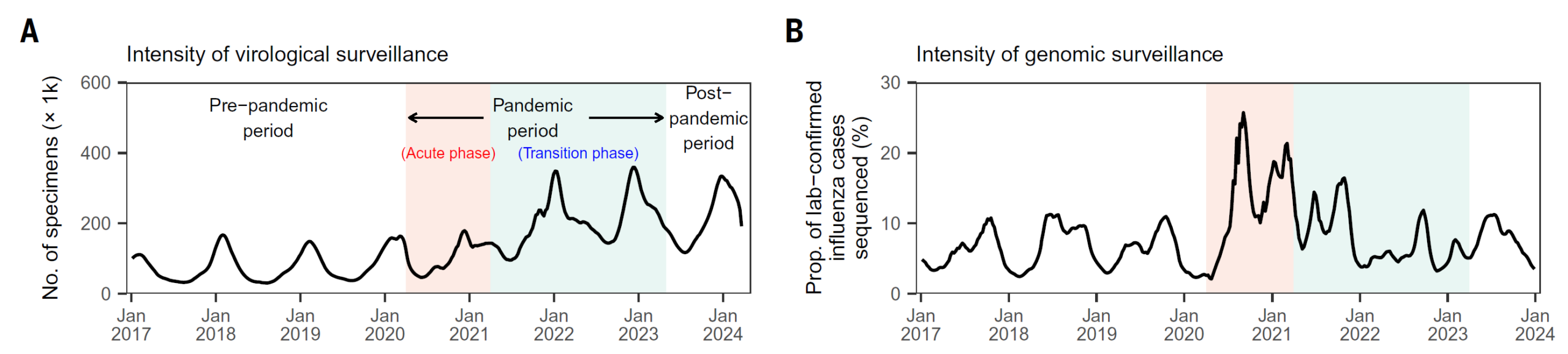
From a 2024 study of this, I’ve poached a couple of excellent images. Worldwide, especially after the peak of the pandemic period (green-coloured region of the graphs), lab testing of samples collected from people for influenza virus increased (black line, part (A)) rather than decreased. Sequencing of influenza virus positives dropped slightly (black line, part (B)) from the peak period but remained elevated during the transition phase.

Figure 1A and B from COVID-19 pandemic interventions reshaped the global dispersal of seasonal influenza viruses. It only shows routes with an average monthly passenger count> 100,000.
Click on the image to enlarge.
Testing in Australia
A few publications have noted the key point: there was a metric s*#t ton of PCR testing for influenza and other respiratory viruses throughout the pandemic.
In the 2022 study below, data from the Australian State of Queensland, obtained via a private laboratory network called Sullivan Nicolaides Pathology, are used from 2015 to 2020. The total number of tests conducted (first column, by year) during 2020 highlights that this laboratory did more testing for non-SARS-CoV-2 viruses than in any of the preceding 5 years. Most of those results identified rhinoviruses – the most common cause of acute respiratory tract infections and illnesses. They also tested 466,931 samples for SARS-CoV-2 (0.08% of these were positive)!
The text goes on to mention that no influenza viruses were detected after testing 163,296 samples during weeks 32 and 36 of 2020, compared to the usual quarter of samples testing positive in previous years.
The next figure shows when and how many more samples were tested than the average of the previous 5 years.
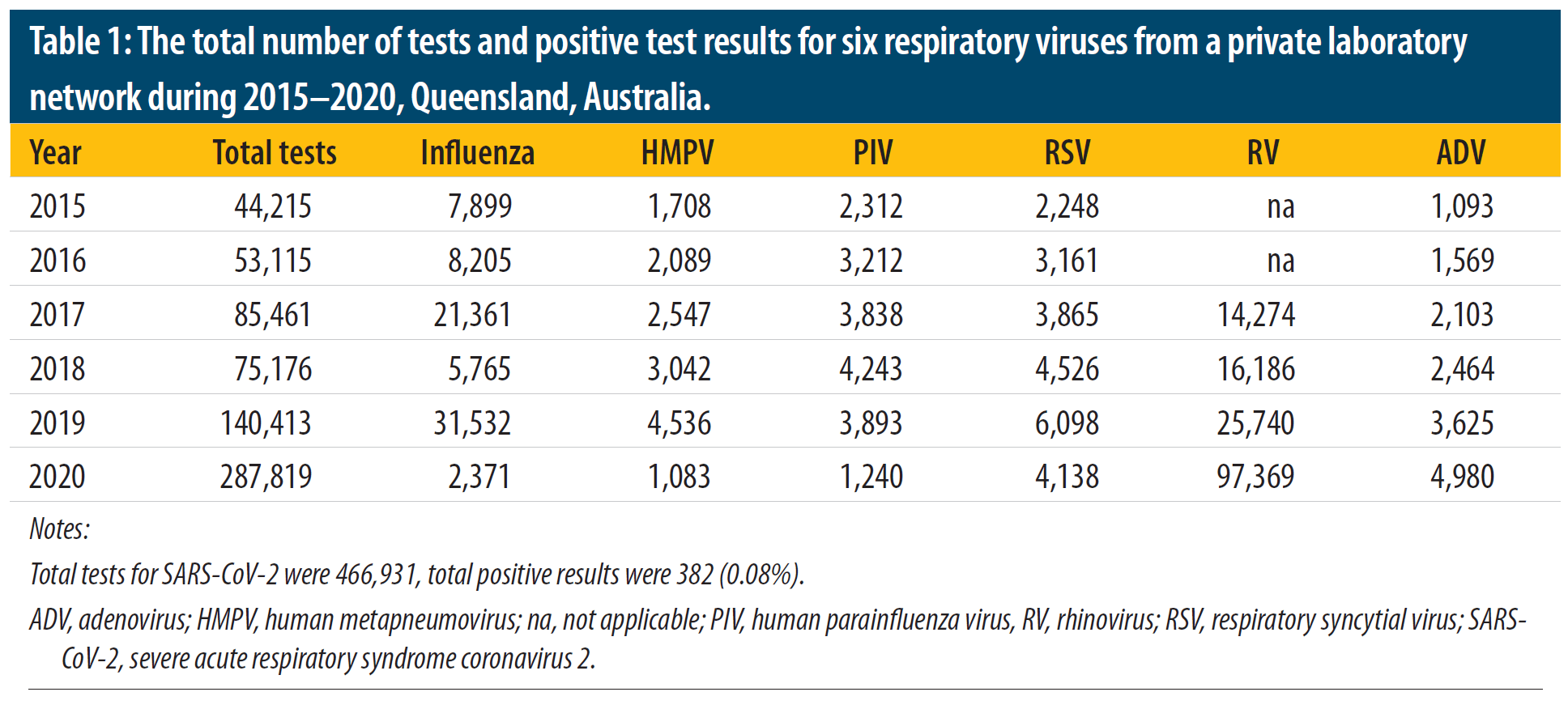
Table 1 from Respiratory virus detection during the COVID-19 pandemic in Queensland, Australia.
Click on the image to enlarge.

Supplementary Figure 1 from Respiratory virus detection during the COVID-19 pandemic in Queensland, Australia.
Click on the image to enlarge.
Below is an image from a 2025 study of Australian flu testing data from 2012 to 2024. The black line shows that influenza testing in Australia also increased during the early acute phase of the pandemic.

Figure 3(a) from Shifts in seasonal influenza patterns in Australia during and after COVID-19: A comprehensive analysis.
Click on the image to enlarge.
Flu is an avid tourist
Seasonal influenza viruses, such as A/H3N2 subtype and B/Victoria lineage, rely on the global movement (journey) of infected people to fuel their spread to new, uninfected people (destination), driving annual epidemics. Its epidemics are influenced by human movement. These epidemics rely on the shipment of newly emerged variants – within infected people – from sites of year-round evolution, such as Southeast Asia, or from a temperate zone during its epidemic, to new sites with people who are not immune, or at least less immune. As I’ve written in older posts,

Figure 1 from Global Migration Dynamics Underlie Evolution and Persistence of Human Influenza A (H3N2).
Click on the image to enlarge.
A journey interrupted
And just to be clear, air travel definitely was dramatically reduced during the COVID-19 pandemic.
Flu’rism (flu-tourism; work with me!) was strangled. Not entirely stopped, and some flu circulation also continued in some parts as we saw above, but its ability to ship novel variants around, including those that were able to grow well and evade prior human immunity to past variants, was severely constrained. You can see the travel impact in the middle image of the figure below, taken from a 2024 study.
In some parts of the tropics, COVID-19 pandemic travel lockdown restrictions meant that distinct influenza virus lineages emerged and spread only within their locked-down environment.
Countries including Australia, New Zealand, and Vietnam saw declines in illness from respiratory pathogens while successfully keeping out SARS-CoV-2-infected travellers during their travel lockdowns. Australia and New Zealand worked hard to increase SARS-CoV-2 immunity through vaccination during this time. All three countries ceased mass air travel routes operating during the acute pandemic period – those moving an average of >100,000 people per month.

Figure 2A, B and C from COVID-19 pandemic interventions reshaped the global dispersal of seasonal influenza viruses. It only shows routes with an average monthly passenger count> 100,000.
Click on the image to enlarge.
What happened once the interventions were dropped?
Once international travel restarted, influenza viruses that were still circulating at low levels in various regions and populations hopped on planes and journeyed to new destinations. And off they went!

We’ve had big and sometimes early, late, or unseasonal flu seasons since, and similar patterns have occurred among other respiratory pathogens as they revisited their favourite destinations after some time to relax and evolve, even though they were driven to low levels.
Eventually, the impact of Infection Pause corrected itself, and we returned to relatively ‘normal’ epidemic periods for all of these endemic viruses, minus B/Yamagata; unless it escapes from the many laboratory stockpiles during routine work with it under lower biosecurity levels because “it’s only the flu” (I’ve been on some research ethics committees🙄).
So that’s the story of hw we smashed flu during the peak of the COVID-19 pandemic. It wasn’t magic; it was all of us working together to protect ourselves from harm. I know-this is a quaint idea in 2026.
References
- ‘Aussie flu’? We can’t be sure where flu originates, and that doesn’t really matter anyway
https://theconversation.com/aussie-flu-we-cant-be-sure-where-flu-originates-and-that-doesnt-really-matter-anyway-89960 - COVID-19 pandemic interventions reshaped the global dispersal of seasonal influenza viruses
https://www.science.org/doi/10.1126/science.adq3003 - Masks matter for more than mandates
https://virologydownunder.com/masks-matter-for-more-than-mandates/ - How immunity shapes the long-term dynamics of influenza H3N2
https://journals.plos.org/ploscompbiol/article?id=10.1371%2Fjournal.pcbi.1012893 - Flu B viruses: why not H-something-N-something?
https://virologydownunder.com/flu-b-viruses-why-not-h-something-n-something/ - Every flu season is a soup of viruses
https://virologydownunder.com/every-flu-season-is-a-soup-of-viruses/ - Implications of the apparent extinction of B/Yamagata-lineage human influenza viruses
https://www.nature.com/articles/s41541-024-01010-y - Global Migration Dynamics Underlie Evolution and Persistence of Human Influenza A (H3N2)
https://journals.plos.org/plospathogens/article?id=10.1371/journal.ppat.1000918 - An early & big flu rise in Australia
https://virologydownunder.com/an-early-big-flu-rise-in-australia/ - Respiratory virus detection during the COVID-19 pandemic in Queensland, Australia.
https://www.sciencedirect.com/science/article/pii/S1326020023003540 - AUSTRALIAN INFLUENZA SURVEILLANCE REPORT, No. 16, 2021, Reporting fortnight: 25 October to 07 November 2021
https://webarchive.nla.gov.au/awa/20230429151623/https://www.health.gov.au/resources/publications/aisr-fortnightly-report-no-16-25-october-to-7-november-2021 - Human seasonal influenza under COVID-19 and the potential consequences of influenza lineage elimination
https://www.nature.com/articles/s41467-022-29402-5 - The Evolutionary Dynamics of Human Influenza B Virus
https://link.springer.com/article/10.1007/s00239-008-9119-z - Influenza in Tropical Regions
https://journals.plos.org/plosmedicine/article?id=10.1371/journal.pmed.0030089 - Unifying Viral Genetics and Human Transportation Data to Predict the Global Transmission Dynamics of Human Influenza H3N2
https://journals.plos.org/plospathogens/article?id=10.1371/journal.ppat.1003932 - Implications of the apparent extinction of B/Yamagata-lineage human influenza viruses
https://www.nature.com/articles/s41541-024-01010-y - Shifts in seasonal influenza patterns in Australia during and after COVID-19: A comprehensive analysis
https://www.sciencedirect.com/science/article/pii/S187603412400354X - Respiratory virus detection during the COVID-19 pandemic in Queensland, Australia
https://pubmed.ncbi.nlm.nih.gov/34648214/ - Rhinovirus rampant or testing triumphant?
https://virologydownunder.com/rhinovirus-rampant-or-testing-triumphant/
The “Infection Pause”: because it’s about fewer infections, not an immune debt to repay
https://virologydownunder.com/the-infection-pause-because-its-about-fewer-infections-not-an-immune-debt-to-repay/
Discover more from Virology Down Under
Subscribe to get the latest posts sent to your email.